
To truly start loving yourself, you first have to understand what is holding you back from having self-love in the first place.
Many of us carry subconscious beliefs shaped by society, culture, family, and media that quietly sabotage our ability to build self-love.
If you’re wondering how to start loving yourself, the first step is awareness. Before you can practice self-love tips or cultivate unconditional self-love, you need to identify the mindsets holding you back and actively release them. Clearing these mental blocks is the foundation to love yourself more and build unshakeable self-esteem.
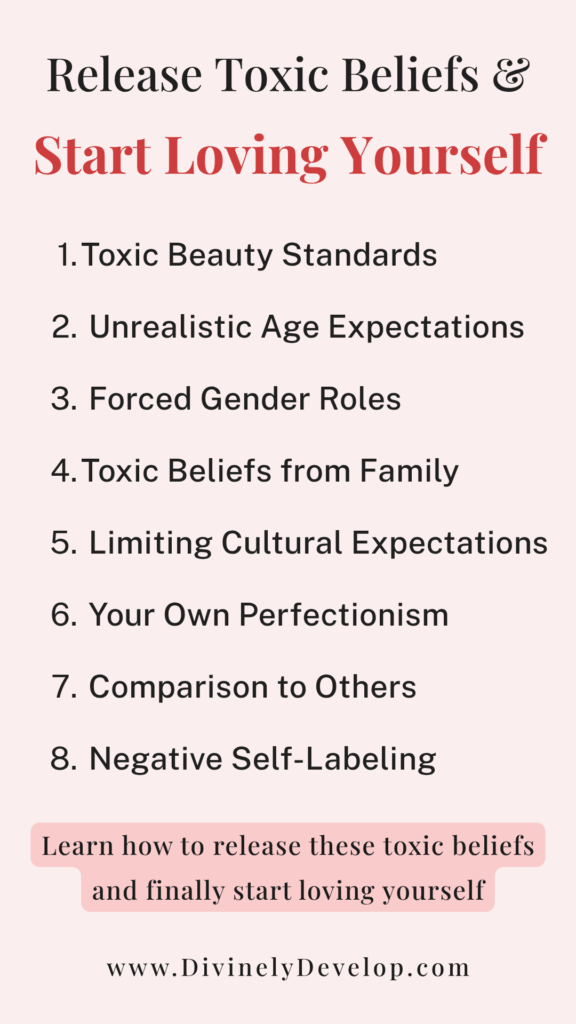
Here are 8 toxic beliefs you have to let go of to create space for real self-love and confidence.
1. Toxic Beauty Standards
From magazines and movies to social media feeds and ads, society constantly feeds us unrealistic beauty standards. The reality? 99% of people don’t—and can’t—meet them.
This programming often begins in our teenage years, quietly shaping how we see ourselves and creating the belief that physical appearance determines our value.
If so many people struggle with self-love and confidence because of these standards, why do they exist? Because negative energy is often the loudest. The people promoting these ideals either benefit from your insecurity or simply operate from a toxic perspective.
If a standard makes 99% of people feel inadequate, it’s not a standard; it’s a system.
In truth, most people don’t fully believe in these standards; they just never questioned them. They accept something as beautiful because others do. Rejecting these standards is not only liberating for you but also an act of rebellion against a toxic societal norm.
Shift your mindset: Start by noticing when you compare yourself to images or expectations you don’t align with. Ask, “Is this standard real, or is it constructed to sell me something?”
How to let go of this belief:
- Unfollow accounts that trigger comparison
- Write down 3 physical traits you genuinely appreciate about yourself daily
- Remind yourself that attraction is subjective, not standardized
Authentic human beauty is diverse: faces, bodies, and skin don’t have to fit a standard to be beautiful and valuable. Celebrate the uniqueness of your features, appreciate your body’s authenticity, and remember: those who truly deserve your energy will love you exactly as you are.
Reflection prompt: What beauty standards do you feel pressured by? How do they make you feel about yourself, and how can you let go of them today?
Related: 27 Powerful Self-Love Affirmations to Rewire Your Inner Voice.

2. Age Expectations
The toxic side of society often glorifies youth while subtly devaluing aging. They promote a message that your twenties are the only years to look, feel, or be “valuable,” and everything after that is a decline.
This creates a powerful fear: that as you age, you become less worthy and less relevant. This belief can deeply impact your self-esteem, make you scared of the future, and prevent you from fully appreciating your life.
But this belief is not truth; it’s conditioning. In reality, most of your life will be spent outside of that small window of “peak youth.” If you believe that only those years are valuable, you’re setting yourself up to feel insecure for the majority of your life.
Letting go of this belief is essential if you want to learn how to start loving yourself, because self-love cannot exist when your worth is tied to something temporary.
Shift your mindset:
Life is not a countdown. Every age and every decade of your life is valuable and worthy of your appreciation. Your body evolving over time is not a loss of value; it is a reflection of life moving forward, exactly as it’s meant to.
How to let go of this belief:
- Write down what your current stage of life has taught you
- Stop consuming content that glorifies only youth
- Practice gratitude for your body and life as they evolve
Reflection prompt: What would it feel like to fully embrace your current stage of life? What about the next decades of your life are you genuinely looking forward to?

3. Gender Roles
Cultural and traditional gender expectations suggest that people must act, think, or pursue goals in specific ways based on gender. “If you’re a woman, you must do X; if you’re a man, you must do Y.”
Gender roles are ultimately limiting and toxic because they restrict freedom of self-expression and authenticity.
The problem isn’t choosing something that aligns with gender roles; the problem is doing it without ever questioning whether it’s actually what you want. When you live according to expectations that aren’t yours, it creates a dissatisfaction, and often it’s your authentic self wanting to be expressed.
If you’re wondering how to start loving yourself, rejecting this mindset is an important step, because you cannot fully love who you are if you don’t know who you are outside of what others tell you you should be.
Shift your mindset: Question every gendered expectation you’ve internalized. Ask yourself: “Is this something I truly want, or something I’ve been taught to want?”
You are not defined by your gender; you are defined by your values, desires, and choices. You have the freedom to create a life that reflects who you truly are, not who others expect you to be.
Choosing yourself may mean that some people won’t understand you, and that’s okay. Being misunderstood is often part of living authentically. In return, you gain something far more valuable: self-respect, clarity, and unconditional self-love.
Reflection prompt: Which gender expectations have influenced your choices? Where in your life are you following expectations instead of your own desires?

4. Toxic Beliefs from Family
Family and upbringing impact our self-love and confidence in ways we aren’t even fully aware of. From a young age, we absorb beliefs, expectations, and opinions that can stay with us forever.
While some of these are supportive, others can be limiting or harmful: “You need to do this…,” “That’s not realistic…,” or “You’re not good enough for that…,” “You shouldn’t do that…”
The truth is that most of our family’s beliefs don’t come from a place of intentional harm. Their beliefs come from their own level of awareness, their fears, their experiences, and the limitations they’ve never questioned themselves.
Ending these patterns is a key step in learning how to start loving yourself, because self-love requires you to define your identity on your own terms, not based on someone else’s expectations.
Shift your mindset: Start identifying which beliefs are truly yours and which were imposed on you. Ask yourself: “Do I actually believe this, or was I taught to believe it?” More importantly, ask: “Does this belief help me grow, or does it hold me back?”
Your family’s perspective is not absolute truth; it is simply a perspective shaped by their own life. You are allowed to outgrow it and think differently. You are allowed to choose beliefs that support your happiness, growth, and self-worth.
Reflection prompt: Which beliefs from your family have shaped how you see yourself? Which of them no longer serve you? What would your life look like if you fully chose your own path and mindset?
Related: 5 Positive Mindset Shifts That Will Help You Feel Better About Life.
5. Cultural Expectations
Every culture has expectations about how people “should” live. While some cultures are beautiful, others are limiting: what career you should pursue, how you should behave, or who you should be.
Certain choices are praised, while others are judged. Over time, this can make you feel like your worth is tied to how well you fit into these expectations.
Majority opinion does not equal truth. Just because something is widely accepted doesn’t mean it’s right.
Following cultural expectations blindly can lead to a life that looks good from the outside but feels empty on the inside. And when you’re living a life that doesn’t align with who you are, it becomes very difficult to truly learn how to start loving yourself.
Shift your mindset: Ask yourself, “Does this expectation actually benefit me, or am I just following it because others do?”
You are not here to meet anyone’s expectations; you are here to create a life that feels right for you. A good life can look very differently for each of us. It is personal and defined by what genuinely fulfills you, not others.
Reflection prompt: Which cultural expectations feel restrictive or misaligned with who you are? Where in your life are you choosing approval over authenticity?

6. Perfectionism
Perfectionism subconsciously convinces you that mistakes, flaws, or setbacks make you unworthy of success, love or respect.
In reality, perfectionism is simply not allowing yourself to be human. You don’t accept mistakes, you don’t accept flaws, and you don’t believe they are worthy of your love.
And because perfection is impossible, you end up in a cycle where nothing ever feels good enough, including yourself. This is one of the biggest blocks to self-love. When your standard is perfection, self-love becomes conditional, you only feel worthy when you meet unrealistic expectations, and anything less creates self-criticism.
The problem isn’t having flaws; the problem is believing you must eliminate them before you can accept and love yourself first.
If you’re wondering how to begin to love yourself, letting go of perfectionism is a crucial step, because self-love cannot exist when it’s constantly being postponed until you become “better.”
Shift your mindset: You don’t need to be perfect to be worthy. Your value is not something you earn through performance; it already exists. The only thing truly worth being a perfectionist about is your mindset, because that has the most impact on how you experience your life.
Reject perfectionism. You are human; allowing yourself to be imperfect is essential to your happiness. Loving yourself means accepting mistakes, growth, and quirks as part of your journey. You can be committed to self-improvement and accept and love yourself as you are at the same time.
Reflection prompt: Where are you holding yourself to impossible standards? In what areas of your life do you feel like nothing is ever “good enough”?
Related: Journaling for Self-Esteem: 40 Prompts to Love Yourself More
7. Comparison to Others
Comparison is often called the thief of joy, and for good reason. The moment you measure your worth against someone else’s appearance, achievements, or life path, you disconnect from your own.
But comparison goes deeper than that. It’s often a sign that you haven’t fully accepted yourself yet. When you compare, you’re subconsciously saying that someone else’s life holds more value than your own.
And that’s not just inaccurate; it’s completely unfair to who you are.
When you compare yourself to someone else, you ignore that reality, and in doing so, you diminish your own worth.
Ending comparison is essential if you want to learn how to start loving yourself, because self-love cannot grow when you constantly place yourself “below” others.
How to let go of this belief:
- Limit exposure to comparison triggers like social media
- Focus on self-improvement, not competition
- Focus on yourself and who you’re becoming
The next time you compare, pause and ask: “What am I not seeing about my own value right now?”
You are not a standard, a role or something that can be measured against another person. You are a complex, unique individual with your own path, strengths, and experiences.
Reflection prompt: When did comparison last steal your joy? What were you overlooking about yourself in that moment?
Related: Complete Guide to Reinventing Yourself (Without Losing Yourself).

8. Negative Self-Labeling
The words you use to describe yourself shape your self-love and confidence. Thoughts like “I’m lazy,” “I’m not good enough,” “I’m awkward,” “I’m weird,” or “There’s something wrong with me” become internalized labels that block your self-love.
But the real issue isn’t just the label; it’s the meaning you attach to it. When you call yourself “shy” or “awkward,” you’re not just describing yourself; you’re judging yourself. You’re deciding that this version of you is somehow not worthy of your own love.
It’s important to remember these labels are not facts; they’re interpretations. And most of the time, they come from past experiences, toxic people’s opinions, or moments where you felt insecure or misunderstood.
Letting go of this pattern is essential if you want to learn how to start loving yourself , because self-love cannot exist when your inner voice is constantly criticizing who you are.
Shift your mindset: Start questioning the labels you use. Ask yourself: “Where did this belief come from?” and “Why do I see this as something negative?”
You are allowed to be a work in progress and still love yourself first. Being shy, quiet, different, or unconventional is not a flaw; it’s simply part of who you are right now. And who you are right now is worthy of love and acceptance, just as you are.
Reflection prompt: What negative labels do you use to describe yourself? Where did they come from?
For more self-love psychology, here are 9 Empowering Self-Help Books for Self-Love and Confidence.
Clearing the Path to Self-Love
Learning how to start loving yourself begins with letting go of these toxic beliefs. By releasing harmful ideas about beauty, age, gender, family, culture, perfectionism, comparison, and negative self-labeling, you create space to build self-love.
Remember: self-love is not something you earn; it’s something you choose. As you remove these blocks, you make room to love yourself first, embrace your authentic self, and appreciate your uniqueness.
Starting this process might feel challenging, but each small release of a toxic belief is a step toward freedom, confidence, and unconditional self-love.
You don’t need to become someone new to love yourself; you just need to stop believing the things that told you you weren’t enough. The more you prioritize loving yourself first, the more effortlessly love flows into every other part of your life.