
Reinventing yourself doesn’t have to be some dramatic, scary process that throws you into an existential crisis.
It isn’t about completely tearing down who you are or pretending to be someone you’re not. Instead, it’s about intentionally creating a version of yourself that feels more aligned with who you want to be and the life you want to live.
Maybe you’re craving change, a new perspective or a life improvement that feels more meaningful and fulfilling. Maybe you’ve outgrown who you once were, and the personality traits, habits and energy that once fit now feel misaligned.
Sometimes reinvention comes from a need to heal, to reconnect with parts of yourself, and sometimes it comes from a simple desire to evolve or to step more fully into your potential.
If you’ve wondered how to reinvent yourself without losing who you truly are, this guide will walk you through every step: from self-discovery to identity shift to fully stepping into your best self.
The Real Meaning of Reinventing Yourself
At the core of reinventing yourself is an identity shift.
Reinventing yourself means aligning with the person you want to become.
Because you are not only your current self. You are also who you are becoming.
The version of you that you imagine when you think about your new self is not random. That desire and vision exist for a reason; they are a reflection of your potential.
An identity shift isn’t just changing habits, it means:
- Becoming the kind of person who naturally practices those habits because they align with who they are.
- Thinking in healthier ways because you genuinely believe those thoughts.
- Embodying personality traits that reflect growth because they feel like you, just a better, more developed version of you.
In the beginning, this can feel like you are “faking it.” But you have to practice being that person before you fully feel like them.
Eventually, it stops being fake. It becomes who you are.
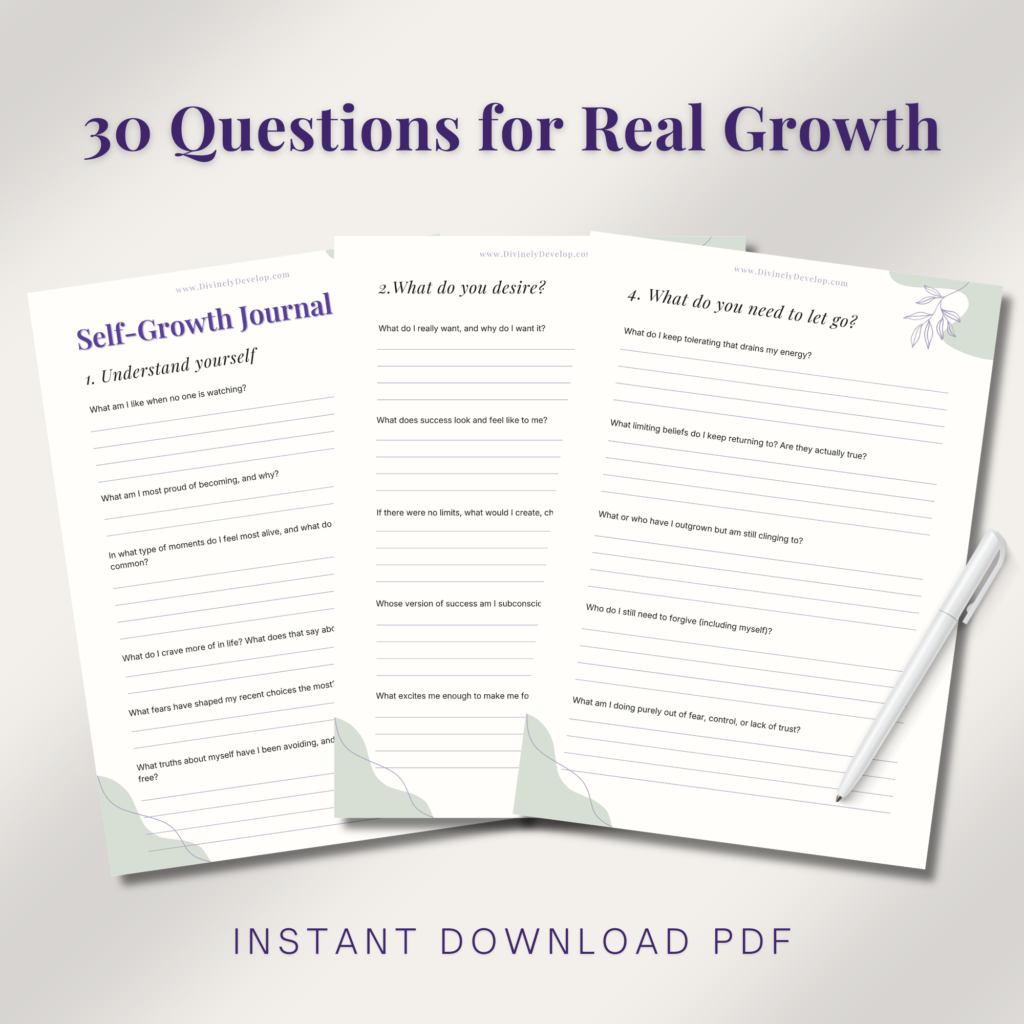
Or get the 28-page Complete Reinvent Yourself Workbook now on Etsy!

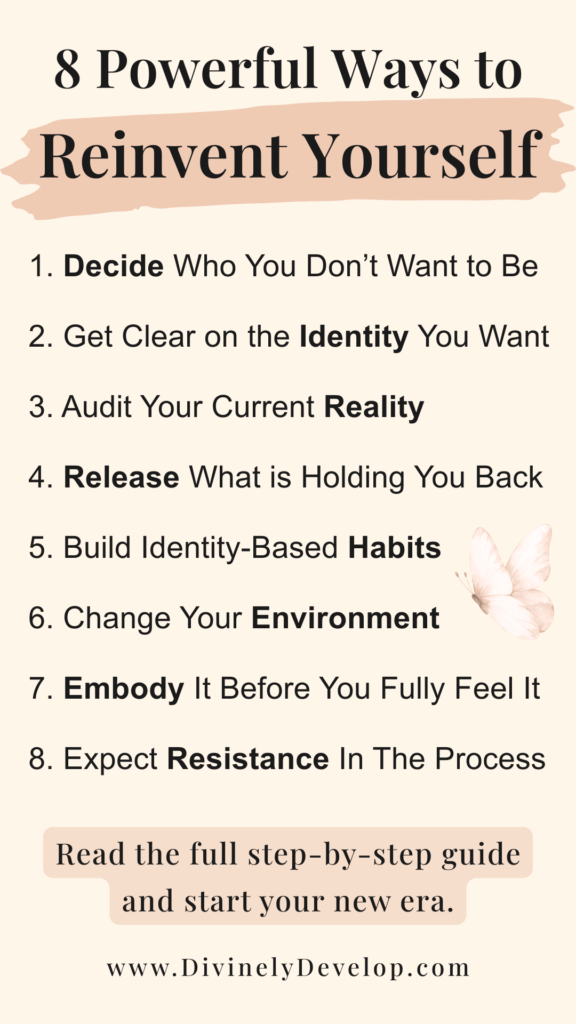
1. Decide Who You Don’t Want to Be Anymore
The beginning of reinventing yourself is not starting positive habits or setting new goals. The beginning is clearing out what you don’t align with anymore.
In other words, before you can understand who you want to become, you first need to decide who you no longer want to be.
This can include:
- Personality traits you’ve outgrown (e.g. reserved, indecisive, quiet)
- Negative beliefs you’re tired of carrying (e.g., self-doubt, lack of self-worth, comparison)
- Labels you’ve attached to yourself (Shy, lazy, insecure)
- Self-sabotaging habits (doom-scrolling, procrastination, overthinking)
- Identities built around past experiences (People-pleaser, perfectionist, annoying)
This process can feel challenging, and that is because it is often the hardest part. Removing negativity is uncomfortable. Facing your own patterns requires honesty and emotional maturity.
But it is also the most crucial part of growth: removing what doesn’t serve you creates space for what will.
Self-Reflection Exercise:
Take a piece of paper or your free printable worksheet, and answer the following prompts honestly:
- Personality Traits: What traits currently define you? Which of these no longer feel aligned with the person you want to become?
- Habits: What habits currently shape your daily life? Which ones support your growth, and which ones hold you back?
- Beliefs: What beliefs about yourself, others, or life do you carry that you want to release?
- Wounds and Patterns: Are there recurring experiences, reactions, or emotional patterns that keep showing up? Which ones are you ready to let go of?
- What You Want to Let Go Of: If you were stepping into a new chapter tomorrow, what parts of your current self would you consciously choose not to bring with you?
Try to be as objective as possible. This process is not meant for criticizing yourself but for understanding yourself.
Related: 5 Positive Mindset Shifts That Will Help You Feel Better About Life.
2. Get Clear on the Identity You Want
Once you’ve reflected on who you no longer want to be, you can gently shift your focus toward who you do want to become. This is where you intentionally define the identity you are stepping into and invent yourself.
You can use the same reflective approach as before, but this time, describe your desired self. Not a perfect or unrealistic version of you, but a version that feels more aligned, more developed and more fulfilled.
Identity-Defining Exercise:
Reflect on different areas of your life and describe your desired self within each one.
- Mindset: How does your desired self think? What values do they embody?
- Self-Image: How do you want to feel about yourself on a daily basis? What kind of relationship do you want to have with yourself?
- Relationships: What kind of friendships or romantic relationships do you want to cultivate? What kind of partner or friend do you want to be?
- Health and Self-Care: How does your future self treat their body?
- Career or Daily Work: What does alignment look like here? Do you value ambition and impact or simplicity and balance?
- Lifestyle and Experiences: Beyond what you were told you should want, what genuinely matters to you? Freedom? Family? Contribution? Peace?
What kinds of experiences would feel fulfilling rather than impressive?
And most importantly, can you feel that version of yourself? If you can genuinely sense what it would feel like to be that person, even for a moment, that is a powerful sign of alignment.
Reinventing yourself is not about becoming someone completely different from your nature. It is about expanding into a more evolved version of who you already are.
Related: How to Glow Up: The Ultimate Guide to Look and Feel Your Best.

3. Audit Your Current Reality
Reinventing yourself requires honesty about where you are right now.
Letting go of who you were might be the most challenging part but changing your current reality might be the part that requires the most effort. Your old identity will not disappear overnight. It will still try to express itself through your habits, your reactions, and your patterns. That is normal.
Habits are not just small repeated actions.
Habits are repeated proof of the person you are and, while reinveting yourself, the proof of the person you want to be.
If you continue acting in ways that reinforce your old identity, it will stay strong. If you begin acting in ways that support your new identity, that identity will start to take root.
This is where intention becomes discipline.
Related: 10 Good Habits That Will Actually Change Your Life.
Reality Audit Exercise:
Take an honest look at your current life and reflect on:
- Your Habits: Do your daily actions reflect the person you want to become?
- Your Relationships: Who in your life supports your growth?
Who subtly reinforces your old patterns? - Your Environment: Look at your living space. Your schedule. Your digital consumption.
Do they reflect your future identity or your past one?
You cannot build a new identity while living entirely inside the system that created the old one.
Changing your current reality means changing how your identity shows up in the world.
And that takes effort. But this is where reinvention becomes real.
4. Release What is Holding You Back
You can define a new identity.
You can change your habits.
Even adjust your environment.
But if old emotional weight or subtle friction is still present, it will eventually slow your progress.
Reinventing yourself is not only behavioral. It is emotional and energetic.
Many people try to move forward while still carrying unprocessed experiences, suppressed emotions, resentment, guilt, or shame. The problem with painful experiences is not only that they happened; it is that they were never fully felt.
And without your awareness and effort, they keep impacting your identity from the background. What you do not process, you unconsciously repeat.
But releasing what holds you back is not always obvious. Sometimes it looks like this:
- Raising your standards
- Ending patterns of tolerating mediocrity
- Cleaning up disorganized systems
- Reducing digital noise
- Saying no to distractions
- Letting go of outdated goals
- Refining who you give access to
Not everything that holds you back is heavy. Sometimes it is subtle misalignment. Sometimes it is comfort. And sometimes it is a version of you that was good enough for a past season but not for the next one.
Or get the 28-page Complete Reinvent Yourself Workbook now on Etsy!

5. Build Identity-Based Habits
Once you have created space, you can begin building.
Instead of asking what habits you should adopt, ask yourself what habits naturally align with your true nature and your desired self.
Maybe you enjoy reading, yoga, nature walks, journaling, strength training, or creative expression. The goal is not to become someone else. It is to become a more developed and intentional version of who you already are.
The key to building any good habit is remembering that no one feels fully comfortable in the beginning. Growth feels unnatural at first because it is unfamiliar.
Research suggests it can take around 3 weeks or more of consistent repetition for a behavior to begin forming into a habit. When you really think about it, that is not that long. The difficulty is not the duration. The difficulty is the beginning.
The first few weeks are the part where you will want to go back to what feels easy.
To scroll instead of focus.
To procrastinate instead of start.
And to stay comfortable instead of grow.
That resistance does not mean the habit is wrong. It means your identity is adjusting.
When the beginning feels uncomfortable, let that be encouragement instead of discouragement. It is proof that something in you is shifting.
Remember who you said you wanted to become. Every small action is a vote for that person.
The first weeks require discipline. But after that, momentum begins to support you.
The discomfort is temporary. The identity you are building can last a lifetime.
The 30-Day Identity Commitment
For the next 30 days, ask yourself daily: What would the person I am becoming do right now?
Then act accordingly, even if it feels slightly uncomfortable.
Consistency builds evidence. Evidence builds belief. Belief strengthens identity.
6. Change Your Environment
Your environment has a stronger impact on your identity than you might realize. If your old identity is deeply tied to your current surroundings, it may be very difficult to grow without changing something externally.
That can mean:
- Redecorating your space
- Changing your social media feed
- Updating your wardrobe
- Rearranging your schedul
- Starting routines in new places
Or it can mean bigger changes:
- Changing jobs
- Moving homes
- Changing friend groups
Your environment either injects negative energy into you or supports your growth.
When I changed my environment, my growth accelerated dramatically. Not because everything became perfect, but because the constant source of negative energy was removed. I had space to practice being my new self without being constantly triggered back into my old identity.
Here are 11 Self-Discovery Questions That Helped Me Build a Life I Love.
Sometimes growth does not require more effort. It requires a different environment.

7. Embody It Before You Fully Feel It
There will be a phase where embodying your new identity feels awkward. You might feel like you are pretending. But often confidence and alignment come after action, not before.
When you visualize your future self and feel into their energy, you are training your mind to accept that identity. Your subconscious does not clearly separate imagination from lived experience. That is why painful memories still feel real when you think about them.
You can use that same mechanism in your favor. Through visualization, affirmations, and intentional behavior, you begin to familiarize yourself with your future identity. Over time, what once felt unnatural starts to feel normal.
It may seem simple, but it is powerful.
This is essentially a “cheat code” for reinventing yourself: by practicing these exercises, you can feel the energy of your new identity, align with it faster, and start naturally acting like the person you want to become. Your habits, routines, and mindset will follow, but most importantly, you will feel like that person from the inside out.
Energy Alignment Exercise:
Identify 3–5 qualities, traits, or energies of your desired self (e.g., confident, joyful, successful) and create affirmations that make you feel that (e.g. I walk through life with confidence”). Then visualize yourself as your new self while saying your affirmations.
See my set of Self-Love and Confidence Printable Affirmation Cards on Etsy!
8. Expect Resistance
There will be resistance on this journey. From old habits. From old thought patterns. Sometimes from other people.
The resistance from others can hurt, but it often reveals misalignment. People who are uncomfortable with your growth or who try to put you down are not meant to walk with you into your future.
Naturally, some people will drift away, and you might even feel alone for a while. That’s okay. The life you’re building, and the self you’re becoming, will be incomparable to what you leave behind.
The most challenging resistance is internal. It is your old identity trying to protect you, trying to keep you in familiar territory. This is where self-awareness is essential. You have to notice when fear is speaking and gently choose differently.
Reinventing yourself is ultimately an act of self-love. It is proof that you value yourself enough to refuse mediocrity, to step out of comfort, and to let go of anything that no longer serves you.
And when you truly understand that, reinventing yourself stops feeling dramatic and starts feeling natural. It becomes less about becoming someone new and more about discovering who you were always meant to be.
Read Next: How to Be Happier: 8 Mindset Shifts That Will Change Your Life.
Or get the 28-page Complete Reinvent Yourself Workbook now on Etsy!
Read Next: How to Start Loving Yourself: 8 Toxic Beliefs to Let Go Of.
Conclusion
Reinventing yourself is not about erasing who you are; it’s about expanding into the fullest, most aligned version of yourself. It’s a process of intentional growth, self-discovery, and self-love. You will face discomfort, old patterns, and resistance, but every small step, every conscious choice, is evidence that you are moving toward the person you are meant to become.
Remember: the life you build by reinventing yourself will reflect the love, care, and attention you give yourself today. By deciding who you don’t want to be, clarifying who you do want to become, and taking consistent, intentional action, you are discovering the most authentic, empowered version of yourself.
The journey may be challenging, but it is also profoundly rewarding. Step forward with curiosity, and trust that every choice you make is shaping the life, and the self, you deserve.