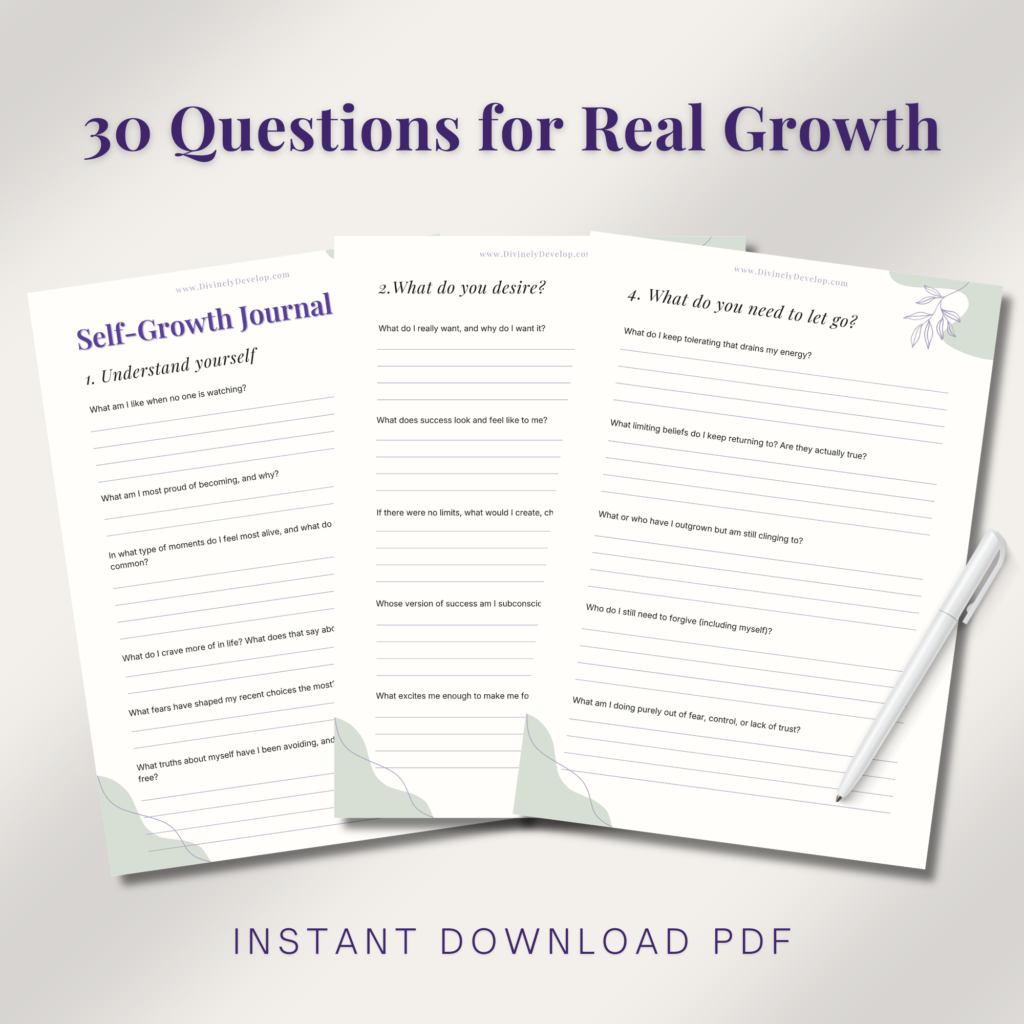

It is a familiar, almost subconscious ritual: you sit down to relax, eat, or simply take a moment of peace for yourself, and within seconds, your phone is in your hand.
You didn’t actively choose to open it; your hands just moved on autopilot.
If this sounds like you, you aren’t alone, and it’s not a personal failure. It is the byproduct of a system designed by psychological experts to keep your eyes glued to a screen.
Data shows that the average person now spends 6 hours and 40 minutes on screens every single day. That number across an average adult lifetime is shocking, amounting to a staggering 11 to 15 years of life spent staring at a screen.
When we look back on our lives in a few years or decades, no one will say, “I wish I spent more time scrolling,” and most of us will regret wasting our best years on meaningless entertainment.
Learning how to do a digital detox isn’t about throwing your phone into the ocean or deleting every profile you own. A realistic detox from social media is about loosening the grip your device has on your brain. Here’s a simple and direct guide to executing a successful digital detoxification and taking back control of your life.
This post contains affiliate links. Read the disclaimer page for more details.

Signs You Might Need a Digital Detox
Admitting that your relationship with technology has crossed a line can be uncomfortable. However, identifying these behaviors is the first step toward reclaiming your life and executing a successful phone detox.
If you are experiencing any of the following signs, it is a clear indicator that your brain needs a digital detoxification:
1. Constantly Checking Your Phone
You unlock your screen out of pure habit, even if you just locked it seconds ago. You aren’t looking for anything specific; your brain is simply on a loop, craving a quick hit of stimulation or a new notification.
2. Doomscrolling
You go to check a single notification and soon realize 45 minutes have passed doomscrolling on social media, sometimes even without any active memory of what you just watched.
3. Experiencing “Post-Scroll Regret”
After spending an hour or two on social media, you don’t feel relaxed or happy. Instead, you are left with a lingering feeling that you just wasted precious time. You might even feel a sense of internal embarrassment or guilt that you allowed your devices to consume so much of your day.
4. Having Disrupted Sleep
Your phone is the very first thing you look at when you open your eyes in the morning and the absolute last thing you look at before closing them at night. If you find yourself scrolling in the dark before sleep or reaching for your phone the second you wake up, your digital habits are actively stealing your rest.
5. Comparing Yourself
As you scroll through your feed, you constantly compare your life to everyone else’s. This leaves you feeling insecure and inadequate, even though you know deep down that social media isn’t reality.

The Psychology of Phone Addiction
Research published in Frontiers in Psychiatry highlights that problematic smartphone use closely mimics traditional addictions, altering both our nervous systems and behavioral patterns.
Psychologists advise that you might need to consciously commit to a detox from social media if you experience these fascinating phone-related phenomena:
- Nomophobia (No-Mobile-Phobia): This is the literal psychological anxiety, elevated heart rate, or respiratory changes experienced when you cannot find your phone or lose cellular service.
- Phantom Vibration Syndrome: A neurological misfire where your brain misinterprets a tiny muscle twitch or the friction of clothes as your phone vibrating. Studies show up to 89% of undergraduates experience this, signaling that the brain is hyper-vigilant and constantly awaiting digital stimulation.
- Digital Anhedonia: Realizing that offline activities you used to love, like reading, drawing, or going for walks, now feel boring or under-stimulating because they don’t offer the rapid-fire dopamine hits of a social media feed.
How to Do a Digital Detox: 7 Realistic Steps
To overcome a system designed to capture your attention, you have to fight design with design. Here are 7 psychology-backed strategies for successfully executing a detox from social media.
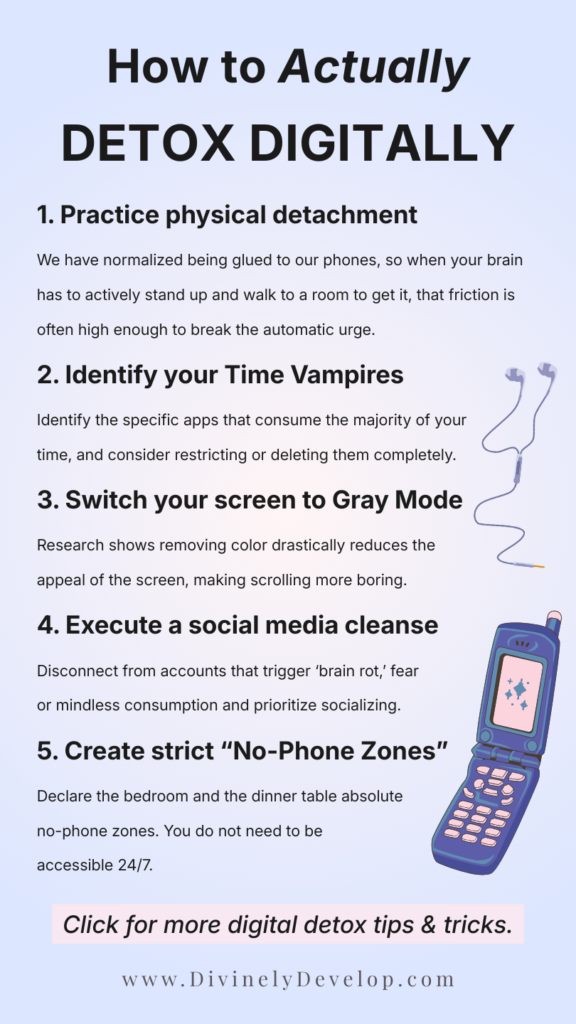
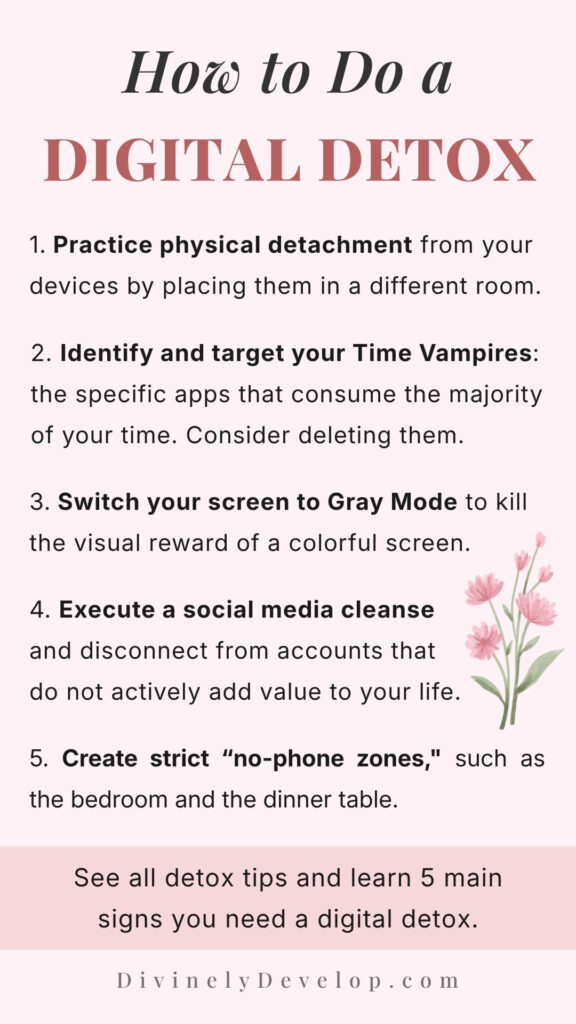
1. Practice Physical Detachment (Increase Friction)
We have normalized carrying our phones into every room like an extra limb, even to the bathroom. Because the phone is always within you, your brain defaults to the path of least resistance: using it.
Think of the solution like a reversal of the habit-making strategies from Atomic Habits. James Clear says that to create a habit, you must make it easy to practice. Similarly, to stop the habit, you must make it difficult to practice.
The Fix: Physically separate yourself from the device.
If you are working from home, reading, or spending time with a loved one, leaving your device behind is the simplest digital detox from phone dependencies.
If your brain has to actively stand up, walk down the room, and retrieve the phone just to check a notification, the friction is often high enough to break the automatic urge.
Realistic Tip: Choose a dedicated timeframe and only allow call notifications, and lock your phone in a lockbox or ask a partner to hide it from you.

2. Identify and Attack Your “Time Vampires”
Look directly at your weekly screen time breakdown in your device settings. Identify the specific apps that consume the majority of your time.
If you look at the data, the culprit is almost always short-form content like TikTok or Instagram Reels. While these apps are built on the premise of connection, short-form video feeds don’t actually help you socialize. Instead, they isolate you in a mindless loop.
Because almost every major app has copied this feature now, it has become the single most common trigger for constant doomscrolling.
The Fix: Attack your top time-wasting app first.
Try to keep only the platforms you actually use to connect with your friends and family. Minimize your short-form video consumption entirely, and consider completely deleting the apps that exist solely for infinite scrolling (like TikTok).
Knowing how to do a digital detox means realizing that you can simply delete your top time-wasting app to break the habit loop and completely remove the ease of scrolling.
Related: How to Make Friends as an Adult (An Honest Guide).
3. Switch Your Screen to Grayscale (Kill the Visual Reward)
Our brains are hardwired to respond to bright, saturated colors. App developers specifically design notification bubbles and vibrant app icons to trigger an evolutionary threat-and-reward response, demanding your attention.
Researchers found that removing color drastically reduces the subconscious appeal of the screen, making long scrolling sessions feel incredibly boring to your brain.
The Fix: Turn on Grayscale mode.
Instantly, Instagram, TikTok, and your home screen turn into a dull, uninviting black-and-white canvas.
4. Execute a Social Media Cleanse
Your digital environment dictates your mental health. If your feed is cluttered with accounts that trigger ‘brain rot,’ comparison, fear or mindless consumption, your brain will remain overstimulated.
The Fix: Disconnect from accounts that do not actively add value to your life.
Re-curate your digital space so that if you do look at your phone, you are met with intentional, limited updates rather than an infinite loop of noise.
5. Create Strict “No-Phone Zones”
You do not need to be accessible 24/7. Establishing physical boundaries within your home helps your nervous system regulate without the constant buzz of notifications.
The Fix: Declare the bedroom and the dinner table absolute “no-phone zones.”
Invest in an alarm clock so your phone does not need to sit on your nightstand. This prevents the habit of scrolling the second you wake up (which spikes your cortisol levels early in the morning) or right before you fall asleep (where blue light disrupts melatonin production).
Read Next: The Ultimate Night Routine for Deep Sleep & Calm Mind.
6. Replace the Scroll (Make the Good Habit Easy)
According to behavioral psychology, you cannot simply eliminate a habit; you have to replace it. If you remove your phone but leave a void, you might quickly revert to your old patterns.
The Fix: Apply the Atomic Habits rule: make the good habit easy.
If you want to learn how to do a social media detox that actually lasts, leave a book open on your couch with a bookmark ready. If you want to practice mindfulness, lay your meditation cushion out in the open. Make your offline hobbies more visible and accessible than your phone.
Need reading inspiration? Check out 25 Best Self-Help Books You’ll Wish You Read Sooner.

7. Consolidate Your Communications to “Batch Checking”
The constant “ping” of messages throughout the day fractures your focus and fragments your attention span. Research shows it takes an average of 23 minutes to refocus on a task after a single interruption.
The Fix: Turn off all non-human notifications.
Then, set specific intervals to check your messages; for example, at 10:00 AM, 2:00 PM, and 6:00 PM. Let your close inner circle know that if there is an emergency, they can call you directly, but texts will be answered during your batch times.
Related: 10 Good Habits That Will Actually Change Your Life.
Extra Tips for a Successful Phone Detox
To give you an extra edge, incorporate these simple, highly effective behavioral hacks into your daily digital detox routine:
- Hide the Temptation: Hide addictive apps entirely from your home screen. Put them inside folders on the last page of your phone, or use your settings to hide them from view.
- Silence the Prompts: Turn off all non-essential notifications completely. Keep your phone’s “Do Not Disturb” or focus functions active.
- Deploy Digital Guards: Set screen-time limits directly within your phone’s settings for the apps you are trying to cut down on. To take it a step further, utilize website and app blockers that physically lock you out of specific platforms once you’ve reached your daily limit.
- Implement a Strict Nightly Digital Shutdown: Pick a realistic time, such as 9:00 PM, where all electronic devices are completely shut down. Use this reclaimed evening window to simply enjoy your own space, read, unwind, or spend high-quality, undistracted time with your partner.
- Introduce Media-Free Days: Commit to one media-free day or weekend as part of your personalized weekly digital detox program. Removing the option of digital entertainment for a set period retrains your brain to seek fulfillment in the real world.
- Find an Accountability Partner: Find a digital detox buddy to keep you accountable. Check in with each other, share your screen time numbers, and offer moral support.
Assessing Your Relationship with the Screen
Before you can change your habits, you need an honest look at the data. Take a moment to answer these four essential self-reflection questions:
1. The Hard Numbers: How Much Time Are You Actually Spending?
The first step is to assess exactly how much time per day you spend on social media and your phone. You don’t have to guess; you can check your exact screen time breakdown directly in your device’s settings.
The Awareness Hack: Leave a screen time reminder widget directly on your home screen. Keeping the numbers right in front of your eyes forces you to remain aware of your usage throughout the day. You can also set reminders within your settings to help you restrict yourself when you cross a certain limit.
2. The Habit Trigger: In What Situations Do You Reach for Your Phone Most?
Pay close attention to when the urge strikes. For most people, the primary trigger is simple: being bored or wanting a quick way to relax while working or doing other daily tasks.
The Reality: Scrolling has become our default form of decompression. Just as previous generations used to unwind by watching TV, we now relax with our phones.
The Problem: Because modern algorithms are so highly sophisticated, the entertainment level is incredibly high and the content is genuinely good. This makes it significantly harder to detach.
If you realize that boredom is driving you to your screen, you must actively find an offline alternative that offers a sense of relief you actually need.
3. The Real-World Cost: Is Your Phone Causing Real Issues?
Be entirely honest with yourself about the real-life effects of your screen time. Is the overuse of social media and your phone causing friction in your day-to-day life? Look out for these common warning signs:
- Disturbed or delayed sleep patterns.
- Friction or distance in your relationships.
- Missing out on important, meaningful moments because your eyes are on a screen.
- Neglecting yourself, your self-care, or another important person in your life.
- Falling into toxic comparison traps.
4. The Time Reclaim: What Would You Do with Your Life?
This is arguably the most powerful question you can ask yourself:
What will you do with the time you get back?
We all have a passion, a hobby, or a personal goal that we claim we wish we could pursue “if we only had more time.”
But if your phone is quietly consuming 4-6 hours of your day, that is exactly where your life is going.
Learning how to do a digital detox successfully starts by reclaiming that time and redirecting it toward things that truly fulfill you.
Take It a Step Further: Read our Complete Guide to Reinventing Yourself (Without Losing Yourself) to design your next chapter.
Reclaiming Your Life
At the end of the day, learning how to do a digital detox isn’t about running away from technology and moving to a deserted island. It is a necessary reality check designed to outsmart the psychological design traps built to steal your attention.
The algorithms, the infinite short-form video feeds, and the notifications will always be there. But your time, specifically those precious 11 to 15 years of life that risk being lost to a screen, will not wait for you.
Executing a realistic detox from social media simply means choosing to be the author of your own life instead of letting a background program dictate your focus.
Start small and expand your digital detox plan as your focus returns. You deserve to break the cycle, protect your peace, and be fully present in your own life.
Frequently Asked Questions
What is the true digital detox meaning?
The core meaning of “digital detox” refers to a designated period during which a person refrains from using electronic devices, such as smartphones and computers, to reduce stress and focus on social interaction in the physical world.
Do I have to delete my social media accounts to do a phone detox?
Absolutely not. A successful detox from social media is about building a sustainable relationship with technology. Instead of deleting accounts, focus on deleting the apps from your phone or use app timers to lock yourself out after a healthy limit.
What are the benefits of a digital detox?
According to experts, reducing chronic screen time lowers cortisol (stress) levels, improves sleep quality by allowing natural melatonin production, boosts attention spans, and enhances deep, real-world connections with the people around you.