
Life is hard, no matter who you are. Every single one of us experiences challenges that feel deeply personal, isolating, and unfair.
It can seem that you were given a harder version of life, but the truth is far less personal: most people struggle in similar ways, just behind different masks.
Life doesn’t magically become easy for anyone. Problems don’t suddenly disappear once you reach a certain level of success, money, or even confidence. Challenges evolve, they shift forms, but they don’t stop showing up.
What does make a difference, and what is almost always within your control, is your mindset.
Now, let’s be clear: this isn’t about toxic positivity or pretending that deeply painful situations don’t exist. Some experiences are heavy, traumatic, or overwhelming, and they deserve time, healing, and sometimes professional support.
But for most of us, the majority of our suffering doesn’t come from the problem itself but from the mindset we bring into it.
If you want to develop a positive mindset, feel happier, and genuinely learn how to feel better about life, these five mindset shifts can change everything.
Life Has No ‘Easy Mode’
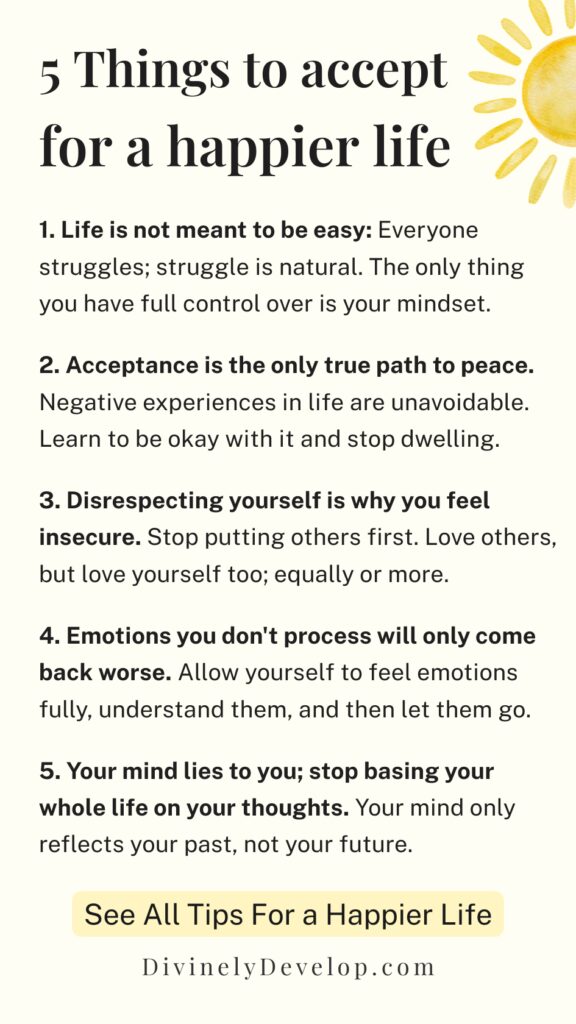
One of the most powerful mindset shifts you can make is accepting reality as it is, not how you wish it were.
Most people live without fully accepting the ‘rules of life.’ Life isn’t a game, but it definitely has some rules you don’t get to change, no matter who you are.
It’s tempting to believe that rich people, celebrities, or highly successful people are living life on easy mode. But that’s not reality.
Every human being struggles with something.
Mental health. Physical health. Trauma. Relationships. Identity. Internal battles don’t disappear because someone has money or status.
Believing that life is harder for you just because you’re not rich or famous only externalizes the solution and takes your power away. You start looking outside yourself instead of realizing that the most impactful changes happen internally.
Yes, life is undeniably harder when basic needs like safety, shelter, and stability aren’t met. But when people compare themselves to the wealthy, they’re usually envying luxury, not survival.
A positive mindset shift here is understanding this: There is a natural difficulty to being alive.
That doesn’t mean you’re failing. It means you’re human.
You don’t have full control over what happens to you, and that’s okay.
What you do have control over is your inner world. Your mindset. The meaning you give things. The way you respond.
Personal growth and self-improvement practices help you take responsibility for your inner state. Spiritual growth goes one step further. It helps you hold life with more perspective, more depth, and less resistance. It doesn’t remove challenges, but it makes them lighter to carry.
Related: 11 Hard Truths About Life & Growth You’ll Want to Remember.

2. Acceptance Is Key to Peace
Accepting that life is hard is one thing. Learning to accept yourself, other people, and what you can’t control is where peace actually begins.
Acceptance is one of the most misunderstood but essential mindset shifts if you want to learn how to feel happier in life.
Acceptance doesn’t mean pretending everything is okay. It doesn’t mean spiritual bypassing or forcing yourself to “let go” of things that still hurt. Some experiences require real time and healing.
But most of the daily frustration we carry comes from resisting things we cannot change.
People’s opinions. How others perceive you. Family dynamics. Past experiences. Certain limitations. Even aspects of your appearance.
When you don’t accept what you can’t control, you let it drag you behind. You keep reopening the same wound, even when there’s nothing new to do about it.
Acceptance of yourself is at the root of real self-love and real confidence. Not the kind based on meeting societal standards, but the kind that comes from choosing not to participate in constant self-judgment.
Acceptance of your family is especially important if you come from dysfunction. Dwelling on what you didn’t have or how things should have been only keeps the pain alive. Often, that pain comes from your inner child, not your adult self, which is why it feels extra heavy.
Acceptance also means understanding that not everyone will like you. Some people will judge you, misunderstand you, or dislike you for reasons that have nothing to do with who you truly are. If you want meaningful relationships or a visible life, this is unavoidable.
The key to practicing acceptance is self-knowledge. Know who you are. Know your intentions and your heart.
Do not let anyone’s limited perspective, or even your own, become your truth.

3. Self-Respect Is Crucial for Happiness
If there’s one thing I’ve learned on my journey to unshakeable confidence, it’s this: self-respect has to be built before self-love and confidence.
Especially when you’re still learning how to love yourself, self-respect is the crucial foundation.
Remember this: you are in a relationship with yourself.
Like in any relationship, love isn’t proven through words. It’s proven through actions and consistency.
We all learn not to fall for words or false promises from others. The same thing applies to your relationship with yourself.
Your mind reacts as if it’s a separate entity. When you act in ways that show disrespect to yourself, you feel it, even if you can’t immediately understand why. The truth is: you proved to yourself that you don’t care about yourself.
When you constantly break promises to yourself, neglect your needs, ignore your mental and physical health, or repeatedly do things that harm you, your mind registers that as a lack of self-respect. And that directly affects how you feel about yourself.
Of course, no one is perfect. We all make occasional unhealthy choices, but what matters is the pattern.
How do you treat yourself most of the time? How do you speak to yourself internally? What thoughts do you allow to dominate your mind? What beliefs do you choose to keep?
Actions are the most direct way to improve your mindset. They tell your nervous system, your subconscious, and your sense of identity that you matter. That you care. That you love yourself enough to show up, even when it’s hard.
Practicing self-respect first is one of the most important mindset shifts that shows you how to feel better about yourself and your life.
Your actions prove your self-worth far louder than any thought ever could.
Related: 9 Empowering Self-Help Books for Self-Love and Confidence.

4. Feel Your Emotions Instead of ‘Outsmarting Them’
This sounds obvious, but it isn’t.
Even after years of personal growth, learning to actually feel my emotions was one of the hardest lessons. Especially if you’re a rational or analytical person, it feels normal to live in your head instead of your body.
Emotions are meant to be felt, not explained away.
When something happens, emotions naturally come up for every one of us. Sadness, anger, shame, rejection, and fear are all natural (and unavoidable) experiences.
Trying to rationalize them instead of feeling them doesn’t make them disappear. It just pushes them down.
Emotions live in the body. When you process them only in your mind, they don’t release; they accumulate.
Often, what you’re feeling isn’t even about the present moment. Emotional triggers are often connected to your inner child. Your adult mind tries to explain it away, but your body just needs to feel it.
When you allow yourself to feel the emotion fully, without judging it or justifying it, the energy moves through you and flows out of your body.
Suppressing your own emotions is the same as when a partner invalidates your emotions in a relationship. Over time, that creates emotional tension, numbness, or heaviness you can’t explain.
Feeling your emotions is not weakness. It’s emotional maturity and one of the most powerful ways to improve your mindset and feel better about yourself.
Related: Complete Guide to Reinventing Yourself (Without Losing Yourself).

5. Your Mind Lies to You – Constantly
This mindset shift changes everything.
Your mind is not the truth. In fact, your mind constantly lies to you.
Your mind operates on a collection of past experiences, beliefs, conditioning, and memories. Most of those beliefs were formed in childhood and never questioned.
Yet you identify with your thoughts as if they are absolute reality.
This is why self-reflection and self-discovery are so crucial for becoming happier in life. Without them, you’re stuck running the same old program in your mind, and it would take countless external experiences to slowly shift that perspective.
The harsh reality is that life mirrors your inner world. If you carry negative beliefs, life won’t hand you positive experiences; it will keep sending challenges your way until you grow through them.
That’s how people get stuck in cycles of suffering.
Just because you think you’re not good enough doesn’t mean it’s true. It means you learned to believe it through societal conditioning designed to keep you small.
Many societal beliefs around beauty, success, and worth are deeply toxic. Following them doesn’t mean you’re doing something wrong; it just means you’re human, and conditioning works on us all until we start rejecting it.
Developing a growth mindset means questioning your thoughts, not blindly following them. It means choosing a more compassionate, evolved perspective, even when your mind resists it.
You don’t have to believe everything you think. And once you realize that, it becomes much easier to improve your mindset and feel happier over time.
Read next: 10 Good Habits That Will Actually Change Your Life.
Conclusion
Mindset shifts don’t magically remove all struggles, but they change how heavy life feels. They give you clarity and control over your inner world, even when the external world keeps challenging you.
If you want to feel happier, improve your mindset, and build a positive mindset that actually lasts, these shifts are where real change begins.
Remember, developing a growth mindset isn’t about pretending life is easy or ignoring your struggles. It’s about taking responsibility for how you respond, choosing self-respect, accepting what you cannot control, feeling your emotions, and questioning the stories your mind tells you.
These mindset tips help you feel better, improve your mindset, and build a positive thinking practice that actually sticks.
Start small, focus on one shift at a time, and watch how your perspective and, therefore, your life slowly and powerfully begin to change.
Share this with someone who could benefit from these mindset shifts.