
Journaling your thoughts and feelings can be a simple yet powerful way to find emotional relief and regain mental clarity. Whether you’re looking to manage anxiety, navigate depression, or process difficult emotions, the right journal prompts for mental health can guide your journey toward healing.
Research shows that journaling can reduce anxiety, help reframe negative thoughts, and even support managing PTSD by providing a safe way to release heavy emotions.
Just like physical health, our mental health requires action and effort to maintain it. There are many ways to support your mental well-being, from talking with an expert to making small, mindful changes in your daily routine.
In this article, we explore the power of journal prompts for mental health, practical ways to use them, and 33 prompts to help you feel better now.
This post contains affiliate links; that means I may earn a commission if you decide to purchase, at no extra cost to you.
The Power of Journal Prompts for Mental Health
Journal prompts provide a structured and guided way to reflect on your thoughts, emotions, and experiences. Like therapy, they ask specific questions that help you break mental barriers and observe yourself from a more objective and compassionate perspective.
Using journal prompts regularly creates a safe space to explore your inner world and process difficult emotions. Over time, this consistent reflection can improve emotional intelligence and build self-love.
Related: Journaling for Self-Esteem: 40 Prompts to Love Yourself More
How to Practice Journaling With Prompts
There are different ways you can incorporate daily mental health journal prompts into your routine, depending on the style you prefer. Here are some effective methods:
1. Writing With Prompts
Writing is the most common way to practice journal prompts. All you need is a quiet space and your favorite journal, whether in paper or digital form. The key to journaling prompts is to write down your thoughts freely, without overthinking or worrying that someone might read it.
Writing down your thoughts in a dedicated journal is a wholesome practice where you sit with yourself and immerse yourself in self-reflection.
Using a digital journal app is great for simple and accessible journaling wherever and whenever you need it. Digital form could potentially be less meaningful but can be equally impactful if you give it enough attention.

2. Voice Recording or Audio Journaling
If your thoughts tend to flow faster than you can write, consider recording your journal entries. Audio journaling provides a different way of connecting with your emotions and is ideal if you prefer to express yourself verbally. It can be a very powerful and emotional practice, as you are having a conversation with yourself about the challenging things in your life.
You can use a voice recorder or an app on your phone to record your answers to these mental health journal prompts for anxiety or any other journal prompts that speak to you.
3. Creative Journaling
Creative journaling is ideal for those who want to express their feelings visually. You can add drawings, photos, or inspiring quotes to your entries. Let your creativity flow—this is about expressing yourself in every way possible.
Creative journaling can help articulate emotions that are difficult to put into words, making the practice both enjoyable and deeply meaningful. Creative journaling can also be one of the most fulfilling ways of journaling for self-care.
Related: 30 Powerful Journal Prompts for Self-Growth and Discovery.

33 Journal Prompts for Mental Health
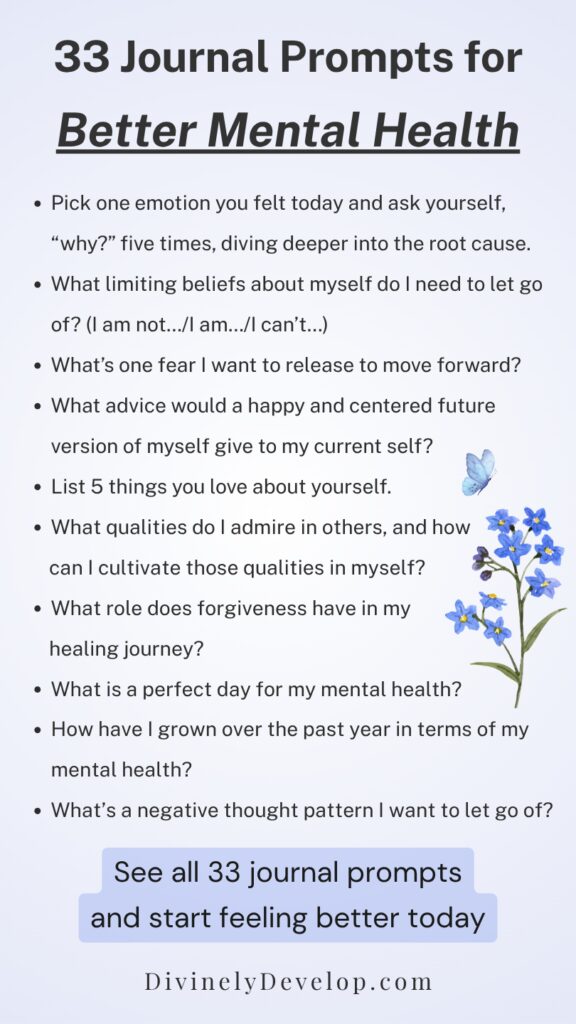
Here are 33 mental health journal prompts to guide you toward emotional healing and self-discovery. Use these daily journaling prompts to reflect and understand yourself better.
- How would I describe the feelings I am feeling right now?
- Pick one emotion you felt today and ask yourself, “why?” five times, diving deeper into the root cause.
- What limiting beliefs about myself do I need to let go of? (I am not…/I am…/I can’t…)
- What’s one fear I want to release in order to move forward?
- What advice would a calm and centered future version of myself give to my current self?
- If my inner critic spoke to a loved one the way it speaks to me, how would I respond?
- What’s one thing I can do today to bring more peace into my life?
- What are three things I am grateful for today?
- List 5 things you love about yourself.
- How do I feel about my relationships, and are there any changes I want to make?
- What qualities do I admire in others, and how can I cultivate those qualities in myself?
- What situations or people trigger negative feelings, and how can I deal with that?
- In what situations do I need to have more boundaries?
- What role does forgiveness have in my healing journey?
- How do I feel about my body today, and how can I show it more love?
- What is a habit I want to break, and why?
- What does self-care look like for me right now?
- List small achievements or tasks you accomplished this week.
- Describe a moment when you felt truly proud of yourself.
- What would I say to my younger self if I could offer some guidance?
- What would a perfect day for my mental health look like?
- What is one thing I can do this week to show myself love?
- What are my biggest sources of joy right now?
- How do I want to feel in the next year? What actions can I take now to get there?
- Write about a recent setback and the lessons you’ve learned from it.
- How do I practice mindfulness in my everyday life?
- When was the last time I felt really calm and at peace? Describe that moment.
- How have I grown over the past year in terms of my mental health?
- How can I celebrate my small wins and progress in my journey?
- What’s a negative thought pattern I want to let go of?
- What fears or worries am I holding onto that no longer serve me?
- What’s one thing I can do today to be kind to myself?
- Write a ‘day in the life’ of your future self that achieved your mental health goals. How do you feel? What do you think about? How does your day look?
For deeper, therapy-style prompts, read Shadow Work Prompts & Meaning: A Beginner’s Guide to Healing.
Final Thoughts
Journaling for mental health is a deeply transformative and personal practice. The most important thing is to truly open up to the process and engage with it authentically.
By incorporating journal prompts for mental health into your routine, you will understand yourself better, lower emotional stress, and enable personal growth. Whether you’re looking for journal prompts for self-love, journal prompts for anxiety, or healing journal prompts, this list has something for you.
Start by truly answering at least one prompt right now and notice how you feel afterwards.
And remember, your emotions are much heavier before you share them, even if it’s just with yourself.